





HALIFAX, NOVA SCOTIA | CANADA B3H 4H9 | +1 (902) 494-3495

About Dalhousie University Schulich School of Law

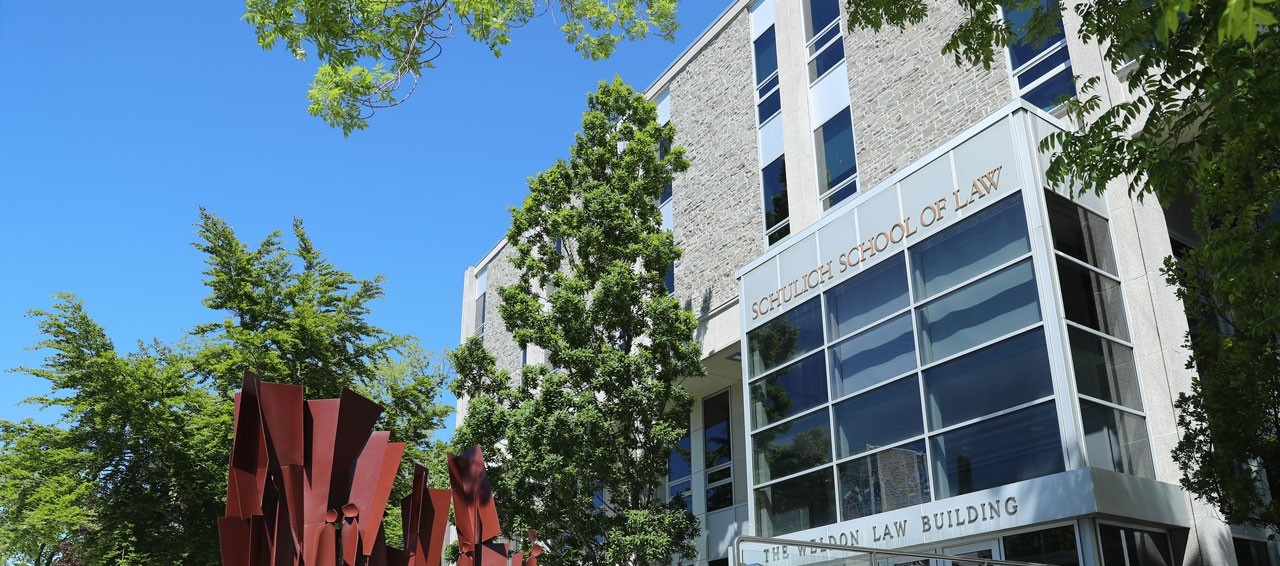
The Schulich School of Law is located in the Weldon Law Building on the main university campus. Designed to meet the special needs of law students and staff, the building contains class and seminar rooms, faculty and administrative offices and lounge space for students and staff. The Sir James Dunn Law Library, which opened in October 1989, houses our collection of over 200,000 volumes of common law materials and legal periodicals which includes a very good selection of international legal materials, and a fast-growing marine and environmental law section. Our international, marine and environmental law holdings are recognized as among the best collections in Canada, attracting scholars from many countries. The law school publishes the Dalhousie Law Journal, a well-respected legal periodical.

LL.B. programme

The full-time LL.B. programme at Dalhousie entails three years of study. The first-year programme is entirely compulsory, while the second- and third-year programmes are, for the most part, optional. The first-year programme consists of the following seven classes: Contracts and Judicial Rule-Making, Criminal Justice: The Individual and the State, Fundamentals of Public Law, Legal Research and Writing, Orientation to Law, Property in its Historical Context, and Tort Law and Damage Compensation. The second-year required classes are Civil Procedure and Constitutional Law. The third-year required class is The Legal Profession and Professional Responsibility. As well, students in second and third year are required to complete at least one major paper class per year.

A limited number of students are permitted to complete their LL.B. on a part-time basis. The intent of this programme is to accommodate the special needs of individuals for whom three years of full-time attendance at law school could cause hardship or even inability to attend at all.

Expertise

Dalhousie University Schulich School of Law offers a wide range of optional classes, but is particularly known for its offerings in the marine and environmental law area, with special emphasis on law of the sea. The Marine and Environmental Law Programme (MELP) now offers about a dozen classes in maritime and environmental law related areas — perhaps the largest curricular offering within the field in North America.

In 2001 Dalhousie's Law and Technology Institute was created in response to the realization that lawmakers and legal scholars face a host of challenging and complex questions as the use of new information technologies grows in all sectors of society. The institute fosters interdisciplinary studies with the Faculty of Computer Science and the Faculty of Management at Dalhousie, and with other institutions. The Schulich School of Law offers several courses to students interested in information technology law issues, including Internet Law, Law and Technology, Privacy Law, and Information Technology Transactions. Students also have the opportunity to conduct advanced research under the supervision of faculty on information technology law issues.

The Health Law Institute has been based in the law school for over 10 years.  This Interdisciplinary Institute of the Schulich School of Law and the Faculties of Medicine, Health Professions and Dentistry is committed to the advancement of health law and policy and the improvement of health care practice and health systems in Canada through scholarly analysis, professional education, and public service. 

The Schulich School of Law has an active clinical law programme, Dalhousie Legal Aid Service. Through its community law office in downtown Halifax, the clinic provides a legal-aid service for low-income clients in the Halifax-Dartmouth area. Students, lawyers and paralegals conduct cases for individual clients and also work in areas of community development, preventive law and law reform, all under the supervision of staff lawyers and faculty members. The clinic also acts as a teaching centre for third-year students. The law school offers another type of clinical experience, dealing solely with criminal law, in which, to complement special classes and seminars, students are assigned to either a judge, a Crown Counsel, or a defence lawyer, to observe and participate in criminal law work. Students receive academic credit for both clinical programmes.

From 1996 - 2001, the Schulich School of Law was also home to the prestigious James Robinson Johnston Endowed Chair in Black Canadian Studies, a national initiative which was established to bring Black culture, reality, perspectives, experiences and concerns into the Academy.

Combined degrees

The law school, in conjunction with several other faculties, offers four combined degree programmes.The LL.B./M.BA. programme allows students to obtain the Bachelor of Laws degree and the Master of Business Administration in four years instead of the five which would be required to take the degrees separately. The LL.B./M.PA. (Bachelor of Laws/Master of Public Administration), the LL.B./M.L.I.S. (Bachelor of Laws/Master of Library and Information Studies), and the recently developed LL.B./M.H.S.A. (Bachelor of Laws/Master of Health Services Administration) are similarly structured to permit the completion of the two degrees in four years instead of the usual five. Students intending to make application to any of the combined programs should inquire directly to the Registrar's Office, Dalhousie University.

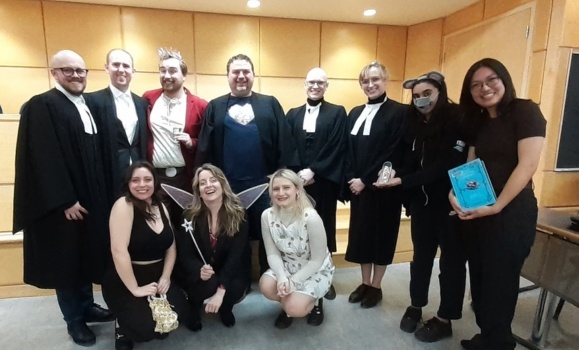
Students are able to participate in several mooting programmes. All second- and third-year students are required to participate in Moot Court, second-year students as counsel, and third-year students as judges. The best second-year counsel compete in their third year for the Smith Shield, a prestigious Dalhousie award. As well, students can participate in the Jessup International Moot Court Competition, a world-wide competition on a problem of international law, the Canadian-American (Trilateral) Moot Court Competition (among Dalhousie University, the University of New Brunswick and the University of Maine), the Laskin Moot (an administrative-constitutional moot), a Securities Law Moot, the Gale Cup Moot Court Competition (among all Canadian common law schools) the Canadian Labour Arbitration Moot and the Sopinka Cup.

The Schulich School of Law, in cooperation with the Supreme Court of Nova Scotia, offers a voluntary Judge's Clerkship Programme for third-year students. This programme, which is in addition to regular classes and not for credit, allows qualified students to spend one week during the term with a Supreme Court Justice in Chambers, and offers a valuable and practical learning experience. Some students each year may also have the opportunity to act as student assistants, for credit, to the N.S. Appeal Court, the Nova Scotia Supreme Court (Family Division) Placement and the Supreme Court of Nova Scotia Placement. 

The Schulich School of Law has established civil law exchanges with two Quebec Institutions (Laval and Sherbrooke), and has a number of international exchange arrangements in place, including ones with the law faculties at the University of Maine, Queensland University of Technology, Maastricht and Vrije in the Netherlands, Lund in Sweden, the private Bucerius Law School in Hamburg, Germany, and the National University of Singapore. It is also party to a multilateral government funded mobility exchange arrangement with The Universities of Houston and Arizona in the United States, and Universidad Panamericana and Monterey Tech in Mexico. Qualified upper year students may apply to study for a term at these institutions, and if accepted, the term counts for academic credit at Dalhousie. The Health Law Institute also has an arrangement which can result in a student studying for a term at Loyola.

The law school has an active graduate degree program, offering both the Master of Laws (LL.M.) and the Doctor in the Science of Law (J.S.D.) degrees. The Master's degree is normally acquired on the basis of thesis and class work, and can be taken either full-time in one year or part-time over two years. The Master's degree may also be taken on the basis of class work only, which is particularly appropriate for part-time students. In recent years, supervision has been offered in the following areas, among others: international law, human rights law, health law, administrative law, constitutional law, taxation, business law, labour law, law of the sea, maritime law, fisheries law, environmental law, critical race and legal theory and feminist legal scholarship. A particular interest has been developed in marine and environmental law, which has been designated as a field of special emphasis in the faculty.